Inevitable
Climbing the Mountain

“When you are in the mountains, if you give up — you die.” — Nims Purja
Last post talked about how low the odds of success are in startups: It’s always 10%.
But that post was missing a key ingredient in the calculus: the founders.
You could argue whether a great founder materially improves the odds of success or not (in that post I argued it still was 10%, largely because of the subsequent challenges you'd need to deal with). But I think the percentage changes are largely overblown for another, more dominant reason: great founders work on really hard problems.
So in a simplistic sense, everything balances out to 10%.
The much more interesting question, in my mind, is simple: what do you do about that?
Unsurprisingly, the answer lies with the person. People are remarkable; our capacity for greatness is extraordinary. And some people have a Messianic ability to fully tap into their potential and will others along with them.
The great founders find a way to make the 10% success become 50%. They create their own luck. They tilt the playing field. They rewrite the rules. They redefine the status quo. They find ways to work 48 hours straight. Whatever they need to do — they do it. They find a way to accomplish the mission.
Like a Marine, when a great founder tells you they're going to do something, you know they'll do it. Obstacles and setbacks still emerge, but they are still able to find a way forward no matter what.
People use different terms for this; resourcefulness, determination, and obssessiveness are some frequently touted traits. I prefer a simpler one.
Is this person inevitable?
Do they have what it takes to do what they say they will do? To warp the world around their willpower?
Everyone has the potential to become inevitable. Few are.
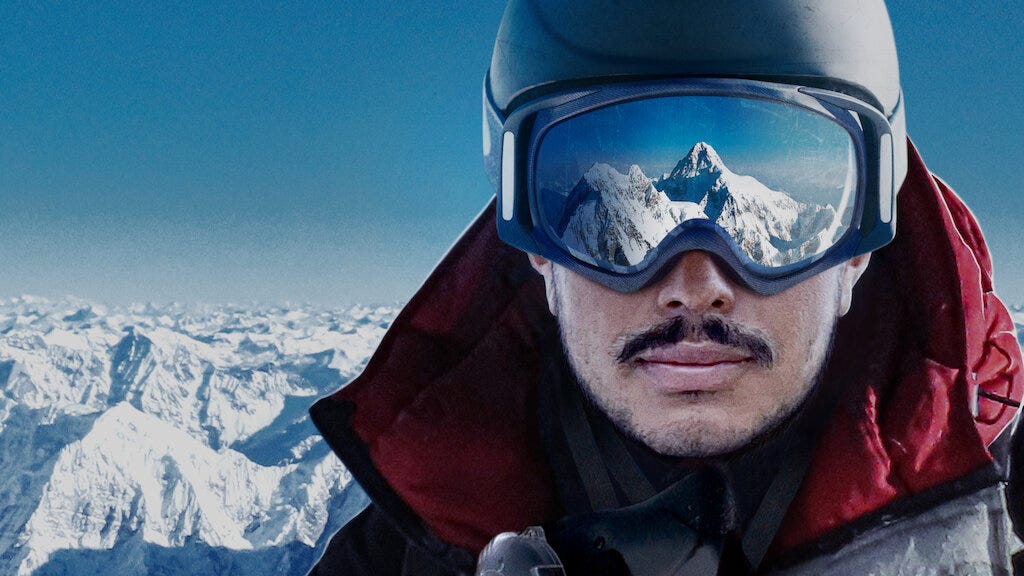
I think about the Netflix documentary 14 Peaks, a story of Nims Purja, the mountaineer who decided to ambitiously summit the 14 tallest mountains in the world. Nims explained the difficulty of the challenge:
The fastest time to climb all 14 8,000 meter peaks was 7 years.
If I can stay alive, I can do this in 7 months.
This is about inspiring the human race.
I was told that my plan was impossible. So I decided to name it project possible.
Just like starting a company, expeditions to 8,000 meters take a huge toll on your body. The chance of success is low, even if you're just trying to climb one mountain (imagine the odds for 14 of them)!
One simple reason is the air. Once you're at 8,000m you're in what is called the death zone. You're breathing about a third of the amount of oxygen you're normally breathing at sea level. And you're trying to carry your body and gear up sheets of rock and ice.
Normally preparing for a single 8,000er is a huge endeavor, often times a full 2 month expedition. Nims proposed doing 2 / month, though in reality he was often doing 3 in as much as 36 hours. You don’t need to be a mountaineer to understand how insane that is.
I mention Nims because he has an inevitability to him. As soon as he steps foot on screen, you can tell he carries a level of willpower and confidence few people can lay claim to. The documentary highlights some of the gifts he was conferred with, but the reason he succeeds is because of his resolve.
And to be clear, he has plenty of fear and doubt during the documentary. He talks through it multiple times; but the flame of underlying belief remains lit the whole time.
He believes — he knows — he can do it. Those ⅒! odds don't apply to him.
Not too different from many other people we also know.
In athletics, I think of Michael Jordan, Tom Brady, Kobe Bryant, Tiger Woods, Michael Phelps, and Apolo Ohno.
In entrepreneurship, I think of Jeff Bezos, Steve Jobs, Jensen Huang, Bill Gates, Elon Musk, Mark Zuckerberg, and Henry Ford.
I’m convinced that if you met any of these individuals from a young age, you’d recognize they had an inevitability to them. Whatever they decided to work on, you knew it would be successful.
Inevitability isn’t a guarantee of success. Travis Kalanick arguably had too much of it. Inevitability is definitely a requirement, though; the harder the challenge, the more it’s needed.
It’s difficult to explain what inevitability is really comprised of; the best definition is probably the same as our definition of desperation – you’ll know it when you see it.
It doesn't matter how extreme the challenge is, I'm not going to give up. — Nims Purja
Startups are really hard. And odds increasingly are stacked against you. That's why 14 Peaks was so poignant. There were so many great quotes that extended to chasing greatness.
In the world of mountaineering, the way you in which you climb the mountain matters. The same is true with life. Approaching things with enthusiasm and focus gives you a much better chance of enjoyment.
That means embracing the setbacks, as difficult as that can be.
When you are in the mountains you find out who you really are. Any mistake I make, it could be death. And when it comes to that moment… you want to survive. You want to live. I climb so I can live every moment of my life.
I like people that do and not chat. You have to be willing to try. Trying also means you have a chance to fail.
You need to take chances and you need to take the risk sometimes in order to make things happen for yourself.
I always say to myself, “I'm not going to die today. Maybe tomorrow, but not today.”
And if you do make it to the top, all the sacrifices become worth it.
On the summit your soul becomes part of the mountain. It makes you feel alive.
This is a longer, and more unusual piece for Odysea, but I think it's an important one. The odds of success really are that low; fortunately, when special people take on impossible challenges, they become possible.
Naval Ravikant has a line how if he lived in 100 different universes, he wants to be the type of person that is successful in 99 of them. That's a similar type of inevitability — no matter what you choose to do in these other universes, you'd still be successful. That's the bar you're looking to hit.
Nims successfully climbed all 14 mountains in 6 months. He also led two successful rescue missions in the middle of his journey, one right after his first summit.
He changed mountaineering forever.
He was inevitable.
I'll end with one of the closing quotes from the documentary:
In life you have to keep doing what you believe. You have to ask yourself, do you really want this from your heart? Is this for the self glory? Or is it for something bigger?
Sometimes the idea that you come up with may seem impossible to the rest of the world, but that doesn't mean it's impossible to you.
And you can inspire one or two people in a good way.
Then you can inspire the world.