
Variance Maxxing
Taking Big Bets and Increasing Your Surface Area

There’s a theory in evolutionary biology called Fisher’s Fundamental Theorem of Natural Selection. It’s the idea that variance equals strength, because the more diverse a population is, the more chances it has to come up with new traits that can be selected for. No one can know what traits will be useful; that’s not how evolution works. But if you create a lot of traits, the useful one—whatever it is—will be in there somewhere.
— Morgan Housel, Same as Ever
Morgan Housel wrote this in the context of predicting the future, but it's equally applicable to the world of startups.1
The theorem was first formulated in Fisher's 1930 book The Genetical Theory of Natural Selection. Fisher likened it to the law of entropy in physics, stating that "It is not a little instructive that so similar a law should hold the supreme position among the biological sciences."
I've spent much of my time writing about Threading the Needle in the context of Amazon going from Books to The Everything Store. But the other, less obvious component to the equation is that Bezos knew he wanted to experiment and take Big Bets. He correctly understood that the best way to build an enduring business was to ruthlessly invent his way into becoming one. The best way to do that is to increase the variance in your gene pool, and create new product and businesses that can grow under the right conditions. You can't prescriptively know which will become massive, but if you work hard enough you'll find the right answers.
This is why I remain favorable to many of the big tech companies pursuing hardware initiatives, even as other analysts like Ben Thompson accurately point out that hardware is not core to their respective businesses. Hardware provides a tangible path towards increasing their surface area as a business.
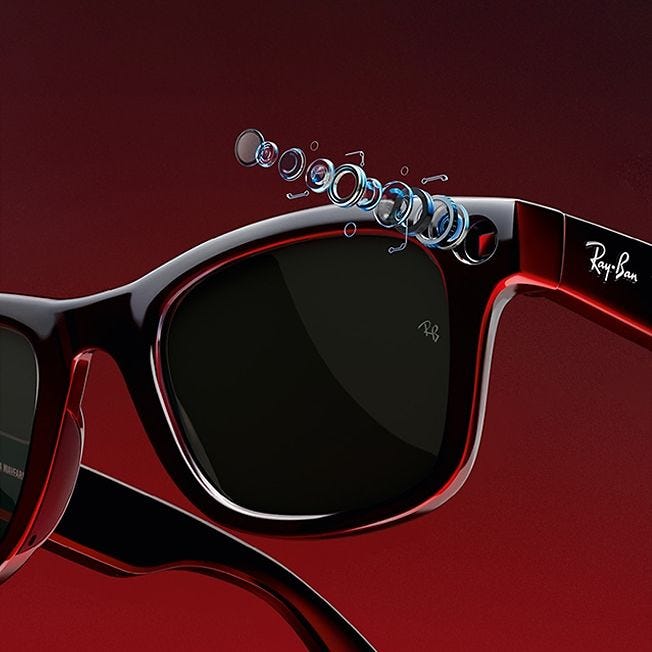
The best example is a recent one: Meta’s Ray-Ban glasses. Andrew Bosworth, Meta’s CTO, shared in an interview how the biggest feature of the smart sunglasses was added on last minute:
“Look at the Meta Ray Ban glasses. We believed this was going to be a great product with just camera video, live streaming, great music, good for calls. That’s it. We were pumped. Six months ago, we’re like, ‘We’ve got to get the assistant on it.’ Now, it’s the best feature of the glasses. Do you know how crazy that is to have a piece of hardware whose killer feature changes six months out? That does not happen.”
This is why Meta, Microsoft, and Google should stay in consumer hardware (Oculus + Xbox/Surface, and Pixel): building great hardware is a muscle you need to develop. And now they can take advantage of opportunities like multimodal AI because they've already been working on strengthening that muscle for multiple years.
This is also why I remain very bullish on the Pixel line, even in spite of its clear shortcomings against the iPhone. The next gen Google Assistant, Pixie, may very well be exclusive to the Pixel 9 lineup.
Everything involves tradeoffs. And exploring Big Bets is no different. In the same book quoted above, Housel talks about how evolution pushes most species towards larger sizes, which makes them more fragile and likely to go extinct.
That's the cautionary side to this strategy: you can try a zillion things at once, but at the end of the day you must be executing against your core business segment, otherwise your business won't exist.
One of my takeaways from studying Amazon is that Jeff Bezos earned the right to build something as monumental (and high margin) as AWS because he found a way to operate in a structurally shitty industry (retail / ecommerce).
Amazon continues to excel in retail, even as they've entered plenty of other markets. They didn't lose track of their core market, and that let them grow into much much more.
We shall see if anyone else can follow suit.
I think this is also fundamentally why I've found the popular disdain for today's levels of progress to be misplaced. So much is happening below the surface that we aren't aware of. LLMs are a fantastic example of that — almost everyone's been blown away by the sudden progress in a category that was almost entirely written off not too long ago.